
I was wowed when I joined an IB school and found teachers going about their daily routine using the complex vocabulary that is part of everyday life in the International Baccalaureate.
“You’ve been courageous today!”
“You displayed great thinking skills while solving this puzzle.”
I longed for the day when I would be well-versed enough to have these terms tumble from my lips and frolic on my fingertips without a second thought. It took years of learning and doing, and it will take many more years to become an expert!
Although I have reached a point of comfort and found that the vocabulary of an IB teacher has become second nature I was confronted with yet another hurdle in my teaching-learning journey. How can I evidence students’ understanding of the ATL in a tangible form?
Why do we need to evidence the ATL?
Educators always put their heart and soul into planning curriculum and learning engagements. Every nuance of the IB is documented in detail while planning, and the ATL is also plugged in. Each learning engagement expects to hone one or more skills that a child needs to become a well-rounded, successful adult.
I was using the correct ATL terms while communicating with my students. They could identify the skills used during each learning engagement. However, I saw that concrete proof of the ATLs was elusive, as it was mainly conversations that revolved around the ATL rather than activities.
Today’s teachers know that data generation is a part of their jobs. It’s essential to have evidence of learning outcomes from your classroom to have a power-packed punch when reporting or during evaluations.

How can I document ATL skills in various ways?
Learning intentions-
Every activity begins by setting a learning intention or goal. This helps students understand the expectations for the upcoming lesson and prepare accordingly. Learning intentions can look like this-
L.I- to research the causes and effects of earthquakes
To add ATL into the learning engagement seamlessly, combine a skill into the learning objective-
L.I- to enhance research skills by inquiring into the causes and effects of earthquakes
By mentioning the skill in the learning intention, you have effectively outlined the lesson plan and highlighted the skill in focus.
Teacher comment/feedback
Once the activity is over, the teacher provides timely feedback. The educator’s comment could look like this-
You were able to find relevant information on earthquakes. Good job!
You can also mention skills in your teacher’s comments to emphasize the skill used during the learning engagement.
You used your research skills to gather information on earthquakes from primary and secondary sources.
Or
You used your thinking skills to break the idea of nouns into smaller parts such as countable and uncountable nouns.

You can also comment on whether the child needs to develop a particular skill. For example, after leaving a comment on whether the child could use their research skills, you could comment on whether they remembered to give credit to their sources or whether they organized their work well (sub-skills).
Exit games
Rather than ATL skills becoming a one-off reflection activity, I like to give ATL and Learner Profile reflection as an exit or entry game. This makes the students more familiar with the ATL as I can draw their attention to the ATL more often as I don’t have to factor in a lot of classroom teaching time to get this done.
Once they’re done with a learning engagement, I give them ruled sticky notes (my favourite stationery item as a teacher!). Students pen down the skill used during the lesson along with the sub-skill. The sticky note acts as their ‘exit ticket’; they can leave for their next class after completing their reflection. Most of the time, fast finishers are raring to begin their reflection as they love the colourful sticky notes and rush to identify sub-skills. Remember that children may select different skills as there could be a few different ones in play at any given time. My students enjoy looking at each other’s work to see if their perspectives on the ATL reflection match!

The sticky can be placed/stuck at the margin of a page so that it can be peeled back to view the work/comments underneath at anytime.
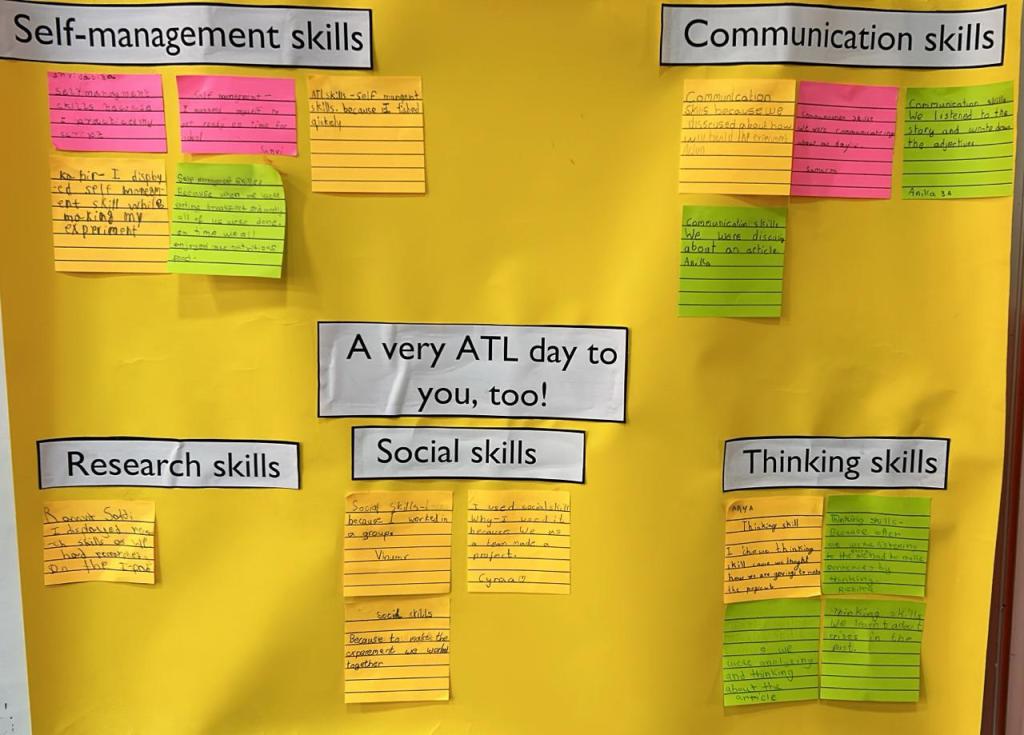
A very ATL day to you, too!
Keep a sheet/chart paper pasted on your classroom door with headings of each ATL skill. Tell your students that whenever they use a skill, they should write it on the sheet. Watch the sheet fill up by the afternoon without carving out any additional time from your lessons! Students will also see how the ATL skills allow them to go about their day, helping them complete mundane and complex tasks. If you want to evidence this in the students’ process journal, you can always take A4 prints of the sheet or take pictures of individual reflections and add them to their notebooks.


ATL checklists-
Create checklists for students to tick after an activity is over. This makes for a quick reflection without taking too much time to write.
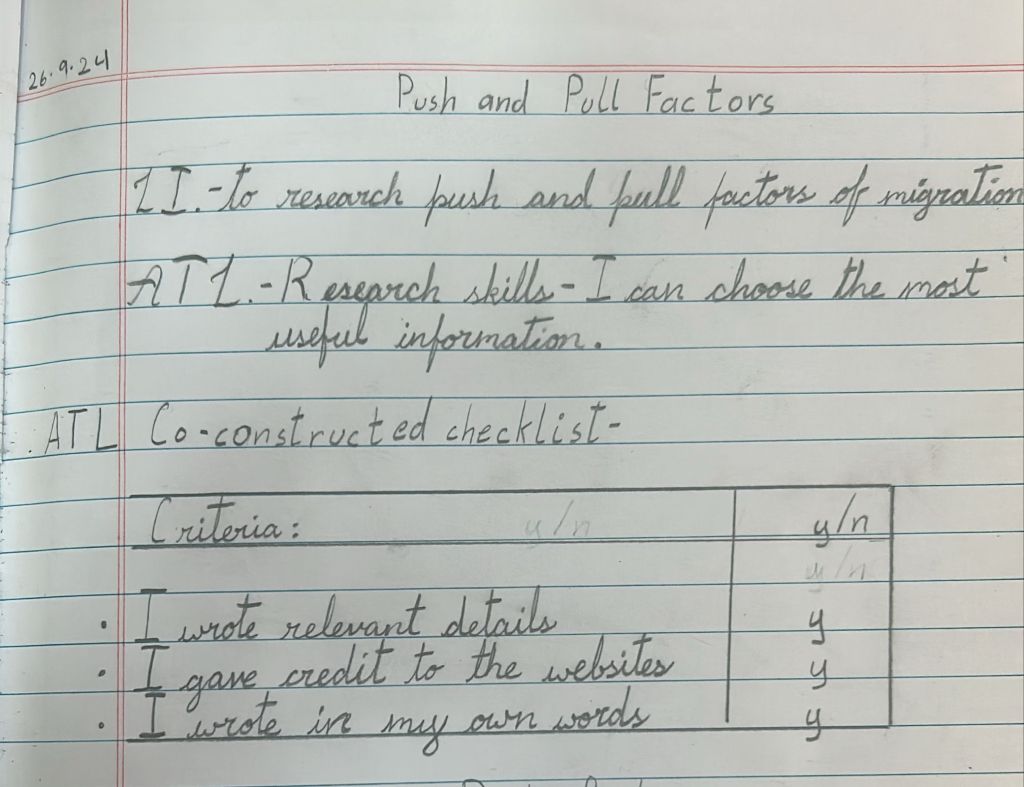
Notice how the checklist ties into the ATL in focus!
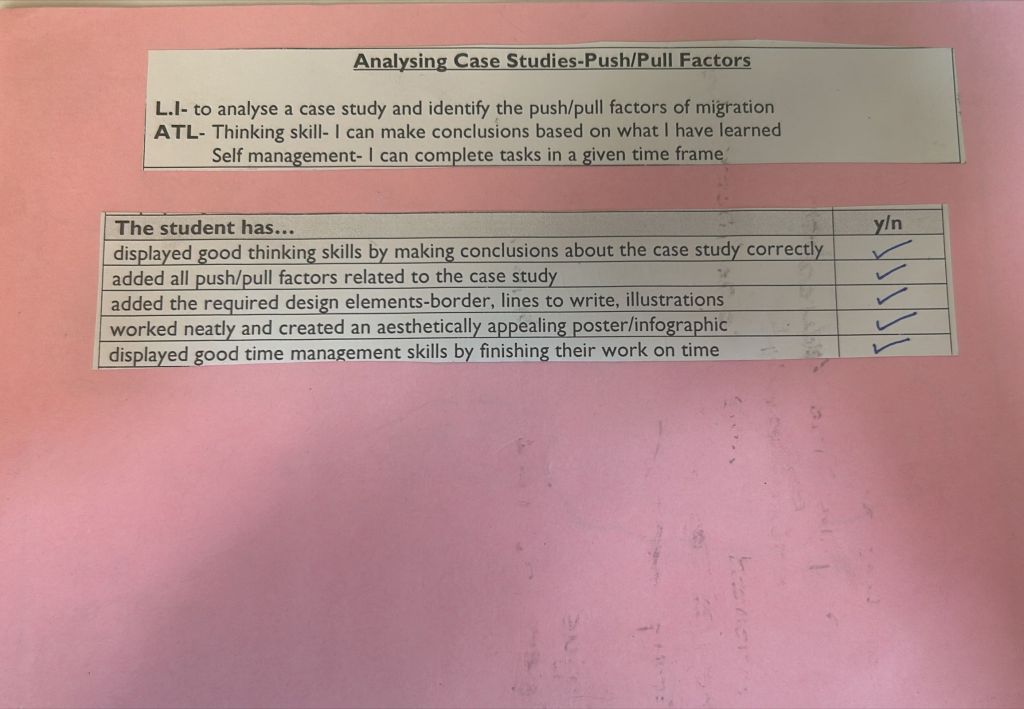
You could also give teacher-marked checklists to ease your checking and include the ATL there as well. For example, my class had to make an infographic on a case study related to migration. The checklist informed them of the essentials of what I needed from the infographic as well as the skills they needed to bring to the fore.

Two stars and a wish strategy-
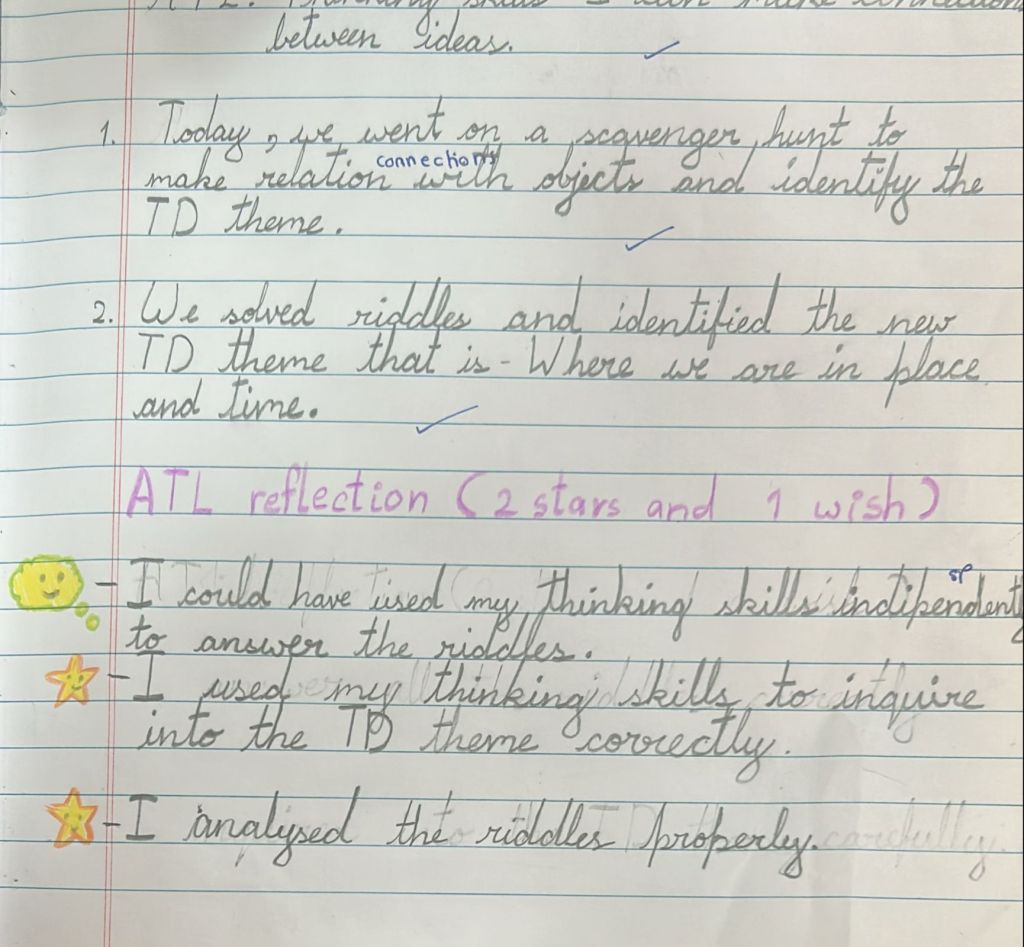
Use strategies like this to get students to intensively focus on the ATL in focus. Be mindful that it is sometimes difficult for students to reflect on a single skill rather than their capability during the whole activity, so make sure you explain the difference between the two clearly.
Students need to mention two things they did well related to the ATL, and one thing they could improve upon next time.
Generic reflections-
You could ask the students to write one thing they did well and one thing they could do better-
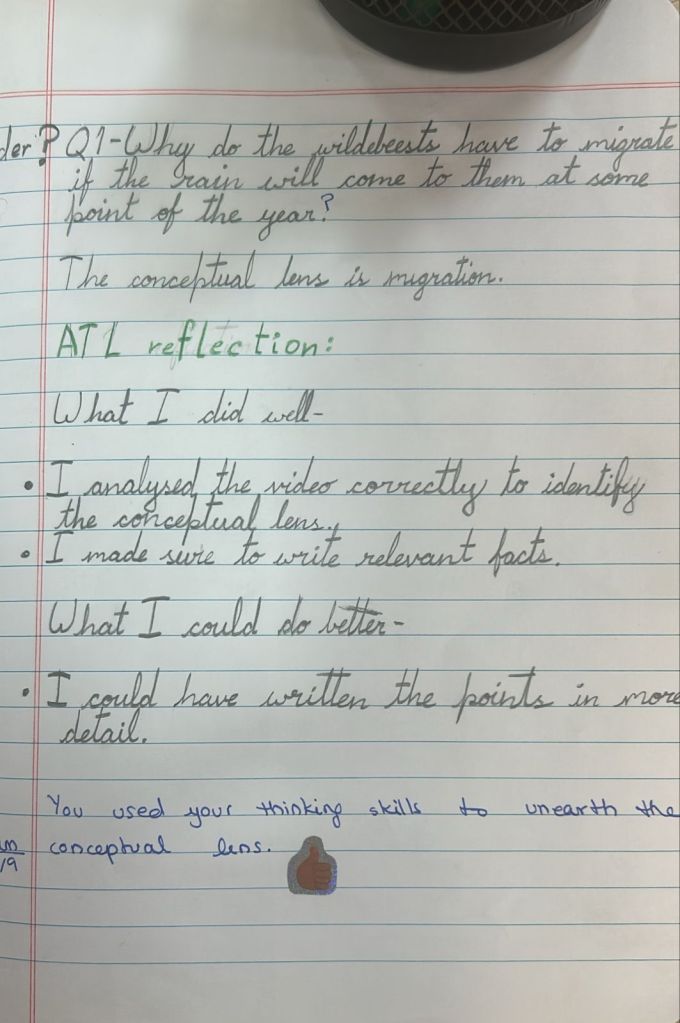
Takeaway-
Evidencing ATL skills should not have to be a chore or take up a big chunk of your lesson time. After all, once ATL skills are taught explicitly to young learners, their reflection should be as seamless as their real-life application.
If you know of other ways to document ATL skills in an exciting and time-saving way, let us know in the comments!
Write for us-
We are reaching out to invite passionate individuals with a flair for writing to contribute to our website. As we strive to create a dynamic platform that fosters learning and knowledge-sharing, we believe in the power of diverse voices and perspectives. If you have a knack for breaking down complex concepts, sharing insightful experiences, or exploring innovative educational approaches, we welcome you to join our community of writers. Check out the ‘Write for Us’ section and send us your work now! We’re waiting to hear from you!



 Looking into the Review Mirror
Leave a reply to pearl Cancel reply