
When I read Lord of the Rings, I was in awe of the one ring to rule them all. Utterly powerful, giving the wearer the utmost control of any situation they could be in. For those who are not Tolkien fans, the one ring could make the wearer vanish, allowing them to escape tricky situations. Everyone desired the power of this ring and sought it throughout Middle Earth.
It may seem a stretch, but as an educator, I likened the one ring to a powerful tool in an educator’s arsenal- a rubric. Rubrics allow teachers to become an invisible part of the student’s journey to display learning, allowing children to navigate their assessments independently.
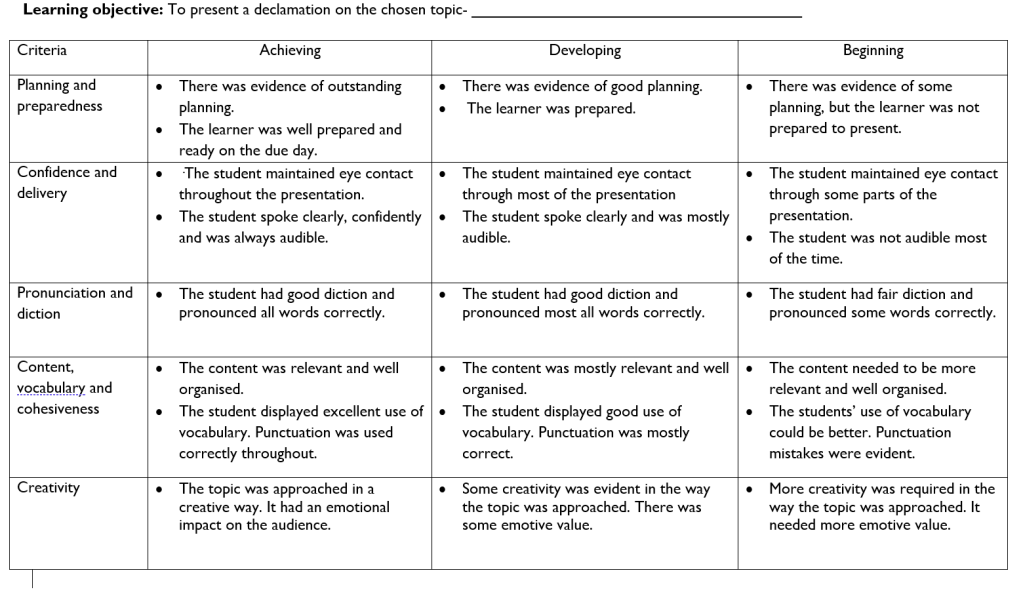
For the uninitiated, a rubric delineates the criteria that must be addressed or demonstrated during an assessment or learning engagement. It articulates distinct levels of performance ranging from exemplary to subpar. This structured tool enhances fairness and clarity in assessing expectations and the quality of work produced. An example is given below.
Why not anecdotal comments?
Initially, I preferred using anecdotal comments for assessment because I could personalise the feedback on each assessment. I would add details on what could be improved next time and compliment the parts of the assessment that stood out. I still believe that anecdotal evidence is a good assessment tool for assessments for learning (formatives) as you can tailor your comments to ensure student growth.
However, anecdotal comments allowed me leeway as a teacher to let subpar teaching slide. I’ll explain.
There have been times when I have rushed a concept (which teacher hasn’t?) and taken a formative too early because of the scarcity of time. Assessments always reflect teaching methodologies, so it stood to form that students did not do well in their assessments. However, a teacher can still paint a rosier picture with their comments through wordplay to hide their teaching inadequacies on paper. As a teacher, they can put down a comment that would make students and parents satisfied that the child hadn’t done a bad job, entirely hiding that they had botched up.
The above is an example of when someone uses the one ring to rule them all for not-entirely-altruistic purposes, vanishing at the time of accountability. This tactic may work for a while, but the all-seeing eye within knows that you messed up and can’t hide from reflection forever.
With no set parameters at the beginning of an assessment, students can go haywire with their assessments, not knowing the criteria they need to strive for to excel.
Why not a checklist?
A checklist is a step in the right direction, as you can give it to students before they begin an assessment. However, this is like wearing a magic ring that doesn’t let the educator vanish entirely, as it’s impossible to give detailed feedback through a checklist. It provides a false sense of power while knowing that ticking yes/no/maybe/needs revision isn’t enough for a student to improve. A one-dimensional ring cannot possibly grant the wearer the power to grant autonomy to learners and become an invisible part of learning. Instead, it requires the facilitator to fade in and out, classifying student learning in shades of black and white, whereas it can sometimes also be grey.
The power of a rubric
Everyone likes to excel, but this becomes more difficult if you’re unsure of expectations. In the same way, a student may think they’ve done an excellent job during an assessment but are crushed to learn that it didn’t go well. This is because an ambiguous assessment leads to mixed results and high expectations.
The power of a rubric lies in laying everything out on the table before an assessment even starts. Every student must go through the rubric to understand the expectations of a particular task. Each criterion in a rubric outlines precisely what a student must do to excel and serves as a foundation for understanding areas of development through self-reflection.
When a cohesive and comprehensive rubric is in place, the teacher can don the one ring to fade into the background, leaving students to traverse their assessments confidently and independently. Feedback is inherent in a rubric if students need to catch up as they can read it to understand where they fell short.
Teachers who use a rubric reinforce that learning should be autonomous and self-driven. Students should be responsible for their learning journey and chart the path forward independently. A well-created rubric does just that.
Key takeaways
- Wield the power of the one ring (use a rubric) judiciously. It isn’t a one-size-fits-all solution to assessments. Rubrics may suit summative assessments or comprehensive learning engagements best.
- When wearing the one ring (using a rubric), ensure the language of the rubric is clear and your outcomes match the assessment. While vanishing is a good idea at times, don’t let the main idea of the assessment vanish, too!
- The one ring (a rubric) allows learners to take ownership of their learning and sets expectations correctly for the task.
The One Ring, a token of shared responsibility and unwavering fellowship, weaves a tale of triumph against adversity. It teaches us that even the smallest among us can make a significant impact, allowing us to create independent learners and efficient teachers of tomorrow.



 Looking into the Review Mirror
Leave a comment